


Key Technologies Behind Effective C-UAS Solutions
September 10, 2026
Counter-Uncrewed Aircraft Systems (C-UAS) have become an increasingly important consideration for defence and security organisations seeking to manage the risks associated with unauthorised or potentially hostile drone activity.
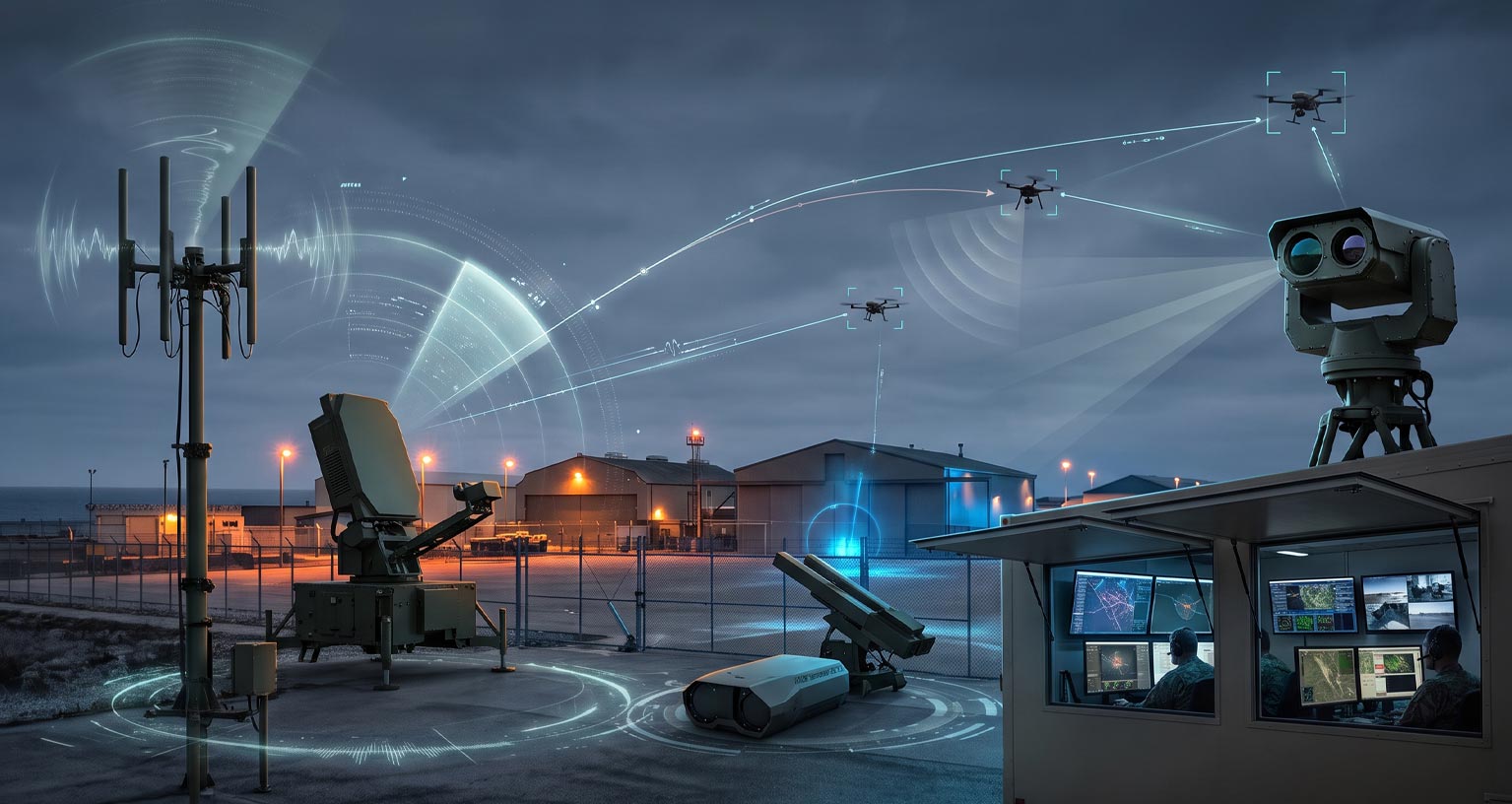
Modern C-UAS solutions typically combine several technologies rather than relying on a single detection or mitigation method. Radar, radio-frequency (RF) sensors, electro-optical and infrared cameras, command-and-control software and appropriate response capabilities can work together to provide situational awareness and support informed decision-making.
Understanding the technologies behind C-UAS systems helps explain how these capabilities contribute to the protection of military sites, personnel and sensitive infrastructure.
Radar Detection
Radar is one of the key technologies used in many C-UAS systems. It works by transmitting radio waves and analysing the signals reflected from objects in the surrounding environment.
Specialised radar systems can be designed to detect and track small aerial objects, including drones. Depending on the system and operating environment, radar can provide information such as an object’s location, direction and movement.
Radar can be particularly useful because it can operate in a range of weather and lighting conditions. However, radar performance can be affected by environmental factors and surrounding objects, making integration with other sensors an important consideration.
Radio-Frequency Detection
Many drones communicate with controllers or other systems using radio-frequency signals. RF detection technology can monitor relevant parts of the radio spectrum and identify signals that may be associated with UAS activity.
RF-based systems can provide information that complements other detection technologies. In some circumstances, they may help identify the presence or location of a drone or its associated control activity.
As with any detection technology, RF monitoring has limitations. Not all UAS operate in the same way, and changes in communications technology can affect how systems are detected. For this reason, RF detection is often most valuable when incorporated into a broader, multi-sensor C-UAS architecture.
Electro-Optical and Infrared Sensors
Electro-optical (EO) and infrared (IR) cameras can provide visual information about objects detected within an area.
EO cameras operate using visible light, while IR systems detect thermal radiation. The two technologies can complement one another and provide additional information for identifying and assessing aerial objects.
Visual confirmation can be particularly useful when security personnel need to establish whether a detected object is a drone or another type of airborne object.
The effectiveness of optical systems can vary according to factors such as lighting, weather and distance, which is why they are generally considered alongside other sensors rather than as a universal detection solution.
Sensor Fusion
One of the most important developments in modern C-UAS is the integration of multiple sensor technologies.
Sensor fusion combines information from different sources to create a more comprehensive picture of activity in the airspace. For example, radar may provide detection and tracking information while EO or IR sensors provide additional visual information.
Combining these data sources can help improve situational awareness and support more accurate assessment of potential threats.
This approach also reduces reliance on a single sensor type, which can be particularly valuable in complex environments where individual technologies may have limitations.
Command-and-Control Systems
Command-and-control (C2) technology provides the link between detection, assessment and response.
Modern C-UAS architectures can bring information from multiple sensors into a central interface, allowing authorised operators to monitor relevant activity and coordinate an appropriate response.
Effective C2 systems can help operators manage information from multiple sources while maintaining an overview of the wider operating environment. Integration with existing defence and security systems can also be important where C-UAS forms part of a larger protection framework.
Electronic Countermeasures
Electronic countermeasures can form part of the mitigation capabilities available within certain C-UAS systems.
These technologies can interact with the radio-frequency environment associated with a UAS and, depending on the system and circumstances, may interfere with communications or navigation functions.
Electronic mitigation must be considered carefully because the radio-frequency environment around military and critical infrastructure can contain many legitimate communications systems. Any capability therefore needs to operate within applicable legal, regulatory and operational requirements.
Electronic countermeasures are also only one potential mitigation approach and may not be suitable for every situation.
Physical and Kinetic Mitigation
Some C-UAS architectures can incorporate physical or kinetic mitigation capabilities where appropriate to the operational requirement and legal framework.
These approaches are generally considered when other measures are insufficient or unsuitable. Their use requires careful assessment of factors including the surrounding environment, potential risks to personnel and property, and applicable rules and authorisations.
For this reason, mitigation should be viewed as part of a wider decision-making process rather than an automatic response to every detected drone.
Artificial Intelligence and Automated Analysis
Artificial intelligence and automated data-processing technologies are increasingly being explored within defence sensing and C-UAS applications.
Processing large volumes of sensor information can be challenging for human operators, particularly in environments containing multiple airborne objects or other sources of activity. Automated analysis may assist with identifying patterns, prioritising information and supporting the classification of detected objects.
However, AI-enabled systems require appropriate testing, validation and assurance. Automated analysis should complement established operational procedures and human decision-making rather than being treated as a substitute for appropriate oversight.
Integration Is Key
No individual technology provides a complete solution to every C-UAS requirement. The effectiveness of a system depends on how its individual components work together and how well they fit within the wider security environment.
When assessing a C-UAS solution, defence organisations may therefore consider:
- Detection and tracking performance.
- Sensor integration and data fusion.
- Identification capabilities.
- Command-and-control functionality.
- Available mitigation options.
- Interoperability with existing systems.
- Cybersecurity.
- Environmental performance.
- Training and maintenance requirements.
- Upgradeability and lifecycle support.
A requirements-led approach allows organisations to select capabilities based on their specific operating environment rather than assuming that one technology will be suitable for every application.
Adapting to Evolving UAS Technology
UAS technology continues to develop, with changes in areas such as communications, autonomy, navigation and sensor capabilities. C-UAS technology therefore needs to evolve alongside the systems it is designed to detect and mitigate.
This makes flexibility and upgradeability important considerations during procurement. Systems that can incorporate software improvements, new sensors or additional capabilities may be better positioned to respond to changing requirements over their operational lifecycle.
Ongoing evaluation is equally important, helping defence organisations understand whether existing capabilities remain appropriate as both technology and security requirements change.
Conclusion
Modern C-UAS solutions rely on a combination of technologies working together. Radar can provide detection and tracking, RF sensors can identify relevant electromagnetic activity, while EO and IR systems can provide additional information for identification and assessment.
Command-and-control systems, sensor fusion and appropriate mitigation technologies then help bring these capabilities together into a coordinated defensive architecture.
The most effective approach is not necessarily to select the most advanced individual technology, but to develop a C-UAS capability that is appropriate to the operational requirement, integrates effectively with existing systems and can adapt as technology changes.
As uncrewed aerial systems continue to evolve, continued investment in detection, identification, integration and responsible mitigation technologies will remain an important consideration for modern defence and security planning.

